Beat Battles Loops and Shop
Exact crate rows, gem efficiency, cassette currency, and which box to open first.
What you are buying
Loops are the clips you drop onto the sequencer. The studio lanes are Drum, Bass, Guitar, FX, Piano Roll, Keys, and Synth. Most of those lanes want recorded loops; Piano Roll also lets you write notes. The shop is how you expand that catalogue with gems. It is a random roll, not a picker: you pay, you get a random loop or a random full pack, you go write a remix.
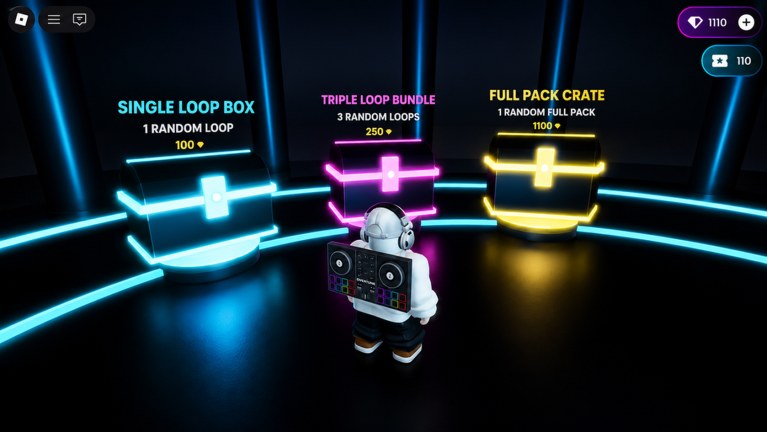
The shop screenshot is the price list. Three crates sit in a cyan ring. Your avatar (backpack mixer, headphones) faces them. Gems show in the top right; cassette currency shows as a second counter. Confirmed gem rows:
| Shop row | Price | Contents |
|---|---|---|
| Single Loop Box | 100 gems | 1 random loop |
| Triple Loop Bundle | 250 gems | 3 random loops |
| Full Pack Crate | 1100 gems | 1 random full pack |
We do not add extra SKUs, fake rarities, or invented cassette prices. If a row is not on that podium, it is not in this table. Arrangement advice for the clips you already own is on remix loops. A pre-set checklist is on the remix checklist.
Gem efficiency math
Per random loop (ignoring pack cohesion):
- Single Loop Box = 100 gems per loop
- Triple Loop Bundle = 250 / 3 = 83.3 gems per loop
- Three singles would cost 300, so the Triple saves 50 gems (16.7%) on the same roll count
Full Pack Crate at 1100 gems:
- Equals 11 Single Loop Boxes
- Equals 4.4 Triple Loop Bundles (4 triples = 1000 gems for 12 loops, with 100 gems left over)
- You cannot convert pack value to a fair “gems per loop” until you know how many loops sit inside a full pack. The label is 1 random full pack, not a loop count
How to read that:
- Triple Loop Bundle is the volume buy. If you need catalogue bulk and you can spare 250, it beats singles on price per roll.
- Single Loop Box is the precision-adjacent buy. You still cannot choose the lane, but you risk only 100 when you are one clip away from a battle-ready Drum or Bass pair.
- Full Pack Crate is the cohesion buy. Pay 1100 when you want a matched set and you will not miss those gems in the next week of battles. Do not open it as a “better Triple.” It is a different product.
Worked examples:
- You have 250 gems and empty Guitar. Buy the Triple. Three rolls beat one roll at 100 with 150 left idle.
- You have 100 gems and a missing kick. Buy the Single. Waiting for 250 while you cannot perform is a hidden cost.
- You have 1110 gems (the shop screenshot number) and a finished battle kit. You can afford a Full Pack Crate and still have 10 gems. Only do that if the pack is more useful than four Triples over time. If you still lack Drum or Bass, buy Triples down to a buffer instead.
A simple rule: do not spend 1100 until Drum and Bass are covered and you can already take a set on stage.
Cassette currency
The shop HUD shows a cassette counter next to gems (110 in the reference shot). The stage HUD shows a cassette count beside the Current DJ name (703 in the battle shot). Cassette is real. Cassette prices are not documented on the three crate labels, which are clearly gem-priced (purple diamond icons at 100 / 250 / 1100). This page will not invent a cassette shop. If a later patch spends cassette on loops, decks, or billboards, it belongs in a new row, not in fan fiction.
Gems remain the currency you budget for the podium in front of you.
What to roll for (lane priority, not loop names)
You cannot pick the loop, but you can decide whether you still need to roll. Rank the holes in your catalogue the same way the Tier List Hub ranks lanes:
- Drum — kick, snare, hats. No battle without this.
- Bass — locks to the kick. Second purchase priority.
- Piano Roll / Guitar — the hook voters remember. Piano Roll can also be written, so you may need fewer guitar loops than you think.
- Keys / Synth — thickness after the groove exists.
- FX — last. Do not spend a Triple hoping for whooshes.
If Drum and Bass already sound like a club, stop rolling until production or curiosity says otherwise. Extra random Guitar that you never sequence is a 83–100 gem souvenir.
Full pack versus three triples
People will argue that 1100 “must” be efficient because it is the expensive crate. Expensive is not efficient.
- Four Triples = 1000 gems = 12 random loops, mixed lanes, no promise they belong together.
- One Full Pack = 1100 gems = one matched pack, unknown size, hopefully one style.
Buy the pack when you want one style kit (for example a set of clips that already sit in the same key and groove). Buy triples when you want coverage across Drum and Bass first. If you only copy the 1100 button because it glows yellow, you are paying a spectacle tax.
Nothing in the shop screenshot says the pack contains decks, stages, or Flame Machine. Those are production unlocks described on DJ decks. Keep crates in the music column.
Codes, gems, and what not to wait for
No promo codes are confirmed. Do not stall a Triple Loop Bundle because a rumor promised free crates. Check Codes when you log in, redeem anything real, then buy according to the table above. A code page is not a shop substitute.
Robux or paid gem top-ups, if they exist in the Roblox prompt, are outside this wiki’s price table. We only document the in-world rows: 100, 250, 1100.
From crate to stage
A loop that never leaves the shop ring is a wasted roll. After each buy:
- Drop the clip on the correct lane. If it is Drum, it fights for the kick slot, not a decoration slot.
- Mute FX if the new clip already carries noise.
- Write a Piano Roll hook in the same key if the pack suggests one (the sequencer chrome in marketing art shows 4/4, 115, A flat minor as an example — follow whatever the clip actually is).
- Run the remix checklist before you queue.
- Take the set on stage the same session. Stars teach you whether the roll was useful. Another crate will not.
Arrangement patterns, stacking rules, and how to avoid FX spam are in remix loops. This page stops at the till.
Shop floor notes from the screenshot
The podium is three crates, left to right: cyan Single, magenta Triple, gold Full Pack. Labels match the table. There is no fourth crate, no “buy this deck” sign, and no cassette price on the boxes. Your mixer is on your back while you shop, which is a useful reminder: the catalogue you are buying is for the DJ the pit will see, not for a single-player album. Spend like you will perform tonight.
If gems are tight, the only “wrong” crate is the Full Pack opened before you have a battle kit. If gems are surplus, the only “wrong” crate is the one you open instead of playing the loops you already rolled. The shop is a refill station. The rank of the refill is on the Tier List Hub; the music you make with it is the rest of the wiki.
Frequently Asked Questions
Quick answers for remixing, voting, and climbing Beat Battles billboards.
What are the Beat Battles shop prices?
Single Loop Box 100 gems (1 random loop), Triple Loop Bundle 250 gems (3 random loops), Full Pack Crate 1100 gems (1 random full pack). Those are the confirmed rows on the crate podium.
Which crate is the best value?
Triple Loop Bundle for volume: about 83 gems per loop versus 100 for singles. Full Pack Crate is a matched-pack purchase at 1100, not a bulk discount unless you specifically want one full pack. Singles are for a cheap extra roll.
What is cassette currency?
A second counter on the shop and stage HUDs. The three crates show gem prices, not cassette prices. We do not invent cassette SKUs.
Can I choose which lane a loop box gives me?
Not on the documented rows. Rolls are random. Decide to buy based on which lanes you still lack, knowing the result might land elsewhere. Prioritize rolling while Drum or Bass is thin.
Are there codes for free loops?
None confirmed. Check Codes for new drops, then come back to this table. Do not delay a 250 Triple on a rumor.
What should I do after I buy loops?
Sequence them, run the remix checklist, and read remix loops if the arrangement is messy. Wear a readable mixer from DJ decks when you take the track on stage.