Beat Battles Production Level and Billboards
The long climb is finished sets and honest votes — not a published XP table and not a crate skip.
Billboards in Beat Battles are the public face of a long climb, not a day-one scoreboard you buy with a Full Pack Crate. Official copy from Overtune puts the pieces in one loop: remix with loops, write on the Piano Roll, battle on stage, vote, unlock DJ Decks / stages / effects, expand the catalogue, level production, climb billboards, and share tracks. This page is that climb. It will not invent XP numbers, level caps, or a hidden meter percentage this wiki has not seen in the live Roblox BETA. The work that feeds the climb is finishing short sets and collecting human stars. How those stars are assigned lives on How to Vote. How a set earns them lives on How to Win Battles. The arrangement habit that makes a set finishable lives on How to Remix Loops.
What official copy actually promises
Overtune’s own feature list is broad on purpose. You remix. You perform. The crowd votes. Then, over time, you unlock new DJ Decks, stages, and effects, you expand the music catalogue, you level production, and you climb billboards. That is the documented long game on a free, 25-player, online BETA that went live on 26 February 2026 and was still updating on the Roblox listing as of 4 September 2026. It is not a tap-arrow rank, not a Friday Night Funkin chart ladder, and not beat-battle.net.
Read the list as a sequence of jobs rather than a loot table. Remixing and Piano Roll writing create the object. Battling puts the object in a room. Voting is the sample. Unlocks are what production level is allowed to open. Catalogue expansion is how the sequencer stays interesting. Billboards are the public proof that you kept doing the jobs. Sharing a track is the export. Skip any job and the climb still exists as chrome, but it stops meaning anything.
Production level is a climb, not a published XP table
This wiki has not confirmed how many points a 5-star set is worth, how many sets sit between unlocks, or whether cassette currency feeds the meter. We will not print a fake curve so the page looks complete. What we can name are the inputs that official copy already groups together: you make tracks, you take them on stage, the crowd assigns 1–5 stars, and production level is the long-term read of that loop.
Practical consequence: a finished 8–16 bar stack that you actually queue is the unit of progress. An unopened crate is not. Sitting in the shop ring hoping a Full Pack at 1100 gems also levels production is a category error. Gems buy loops. Production opens wearable and room catalogue over time. Stars come from other players. Keep those three pipes separate, then walk them in that order. Wallet detail for the gem pipe lives on gems. Deck identity that production can eventually hand you lives on DJ Decks.
Because the XP table is unpublished, the only honest grind is repetition you would have done anyway. Finish a set. Match the posted theme. Collect votes. Vote the next Current DJ. Fix the quietest lane. Queue again. That loop is slower than a spreadsheet and more reliable than a rumor that 50 flames equal a level. If a later BETA build posts numbers, this page will cite them. Until then, treat every invented XP screenshot as fan fiction.
Unlocks sit behind the climb, not in front of it
DJ Decks, stages, and effects are the three named unlock buckets. Official copy ties them to leveling production and climbing billboards. It does not put a gem SKU on a named mixer, a named room, or a named extra machine in the shop we can see. The shop rows that do exist are still the loop boxes: Single Loop Box 100 gems, Triple Loop Bundle 250, Full Pack Crate 1100, with cassette as a second counter beside purple gems. Spend gems to fill Drum or Bass. Let production hand you the backpack, the room, and extra Stage Controls.
That split keeps the climb from turning into a mall. A new deck is a silhouette the pit can read. A new stage is a room with different sightlines. A new effect is another dressing tool next to Starter Spotlights and the Flame Machine. None of those replace a hook. If you are still losing stars because the intro is timid or the theme is wrong, stay on How to Win Battles until the set is loud from bar one. Then let billboards catch up. Chasing a deck to postpone a remix is how people stall in the crate ring for an hour and still have empty Guitar.
Effects you already have still count as production-adjacent tools, not as XP cheats. Fire them once at the hook. The crowd is scoring music. Production is scoring the habit of finishing and performing that music. Confusing the two is how Flame Machine spam starts to feel like a grind strategy.
Catalogue growth uses the same sequencer studio
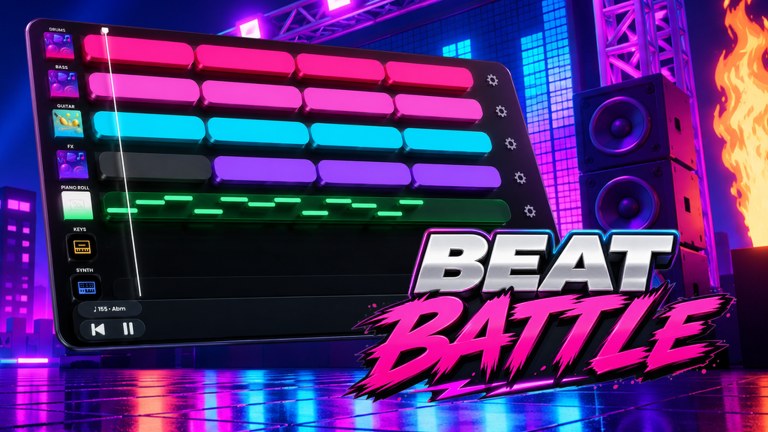
Expanding the catalogue is the other half of the official loop. In Roblox that currently means rolling loops into the seven lanes: Drum, Bass, Guitar, FX, Piano Roll, Keys, and Synth. Arrangement order for those lanes is still drums-first, FX last, as How to Remix Loops already teaches. Production level does not rewrite that order. It only makes the library behind the order less thin over time.
The video on this page is the official Overtune clip about importing any sound into the sequencer. Treat it as catalogue and production context for the same studio family Beat Battles uses, not as a Roblox-only patch note and not as a promise that the live BETA already shipped a full import button with a published file list. Overtune’s engine is a music-making surface: lanes, a visible project, clips you can hear immediately. A wider sound library is how you keep leveling the craft instead of repeating one kick. If import lands in the Roblox client later, it will still serve that catalogue job. Until a listing or HUD label says otherwise, do not rebuild your gem plan around a studio-brand feature as if it were a September 2026 crate SKU.
The honest catalogue path in the current shop remains small boxes first. A Single Loop Box fills one hole. A Triple Loop Bundle is the volume buy. A Full Pack Crate is a cohesion dump for players who already finish sets. Production level is what you are doing while those boxes accumulate — not a substitute for choosing which lane is silent.
Billboards are public proof, not a lobby title you can buy
A billboard is useful because other people can see that you kept finishing tracks. It is not a private rank you purchase, and it is not a Standout Games badge. Roblox hand-picking the experience for a rotating front-page slot is distribution; it is not your personal meter. Context for that mention lives on Standout Games. Your climb is still local to play: remix, battle, vote, unlock, expand, level, appear on billboards, share.
Because the room is 25 players, billboards only stay readable if votes stay honest. A circle that 5-stars every friend and 1-stars everyone else is printing fake production. That is why How to Vote belongs in the same week as this page. You cannot climb a public board on a sample the room no longer trusts. Stay after YOU’RE UP!. Score the Current DJ. Then take the next short set.
Do not wait for a promo code to start the climb. As of September 2026 this wiki has not confirmed working codes. Do not wait for a script that auto-queues empty stacks. There are no confirmed game-specific scripts, and auto-play would make billboards worthless. The BETA is already playable. Servers are already online. The long game starts the first time you finish 8–16 bars and let a crowd hear them.
A climb order that does not invent XP
- Finish a short remix with Drum, Bass, and a hook. Arrangement detail is on How to Remix Loops.
- Queue, match the theme, play when YOU’RE UP!, and stop before the set rambles. Stage detail is on How to Win Battles.
- Vote every set you heard. Listener detail is on How to Vote.
- Spend gems on the silent lane, not on a hope that 1100 gems also levels production. Wallet detail is on gems.
- Equip DJ Decks, stages, and effects when production actually offers them, and only if they stay readable. Deck identity is on DJ Decks.
- Treat catalogue growth — including Overtune’s broader import-any-sound studio story — as fuel for the next finished set, not as a patch rumor.
- Let billboards reflect that loop. Do not buy a title. Do not invent a point value. Repeat the loop.
That order is the whole long game this wiki can document without lying about numbers. Production level is the unnamed meter. Billboards are the public readout. Finished, voted sets are the only fuel we can name.
Frequently Asked Questions
Quick answers for remixing, voting, and climbing Beat Battles billboards.
How do production level and billboards work in Beat Battles?
Official copy ties them to finishing tracks, battling, voting, unlocking DJ Decks / stages / effects, and expanding the catalogue. This wiki has not confirmed XP numbers, so treat finished, voted sets as the unit of climb.
Does buying a Full Pack Crate level production?
Not in any confirmed way. Gems buy loops at 100, 250, and 1100. Production opens unlocks over time. See gems for the wallet split, then queue a finished set.
What unlocks when I climb billboards?
Official buckets are new DJ Decks, stages, and effects, plus a wider catalogue. Deck identity is on DJ Decks. We do not list invented SKUs or point thresholds.
Is the import-any-sound video a Roblox patch note?
No. It is official Overtune sequencer context for catalogue and production craft — the same studio family — not a claim that a dated Roblox patch shipped a full importer.
Do honest votes really affect the climb?
Billboards only mean something if stars are a human sample. Stay after your set and follow How to Vote. Winning the booth itself is on How to Win Battles.
Is a Standout Games feature the same as my billboard rank?
No. Standout is Roblox distribution for the experience. Your climb is play. Read Standout Games for that distinction, then go finish another short remix.