How to Win Beat Battles
Front-load the hook, match the room, dress the set once, and treat stars as a social loop.
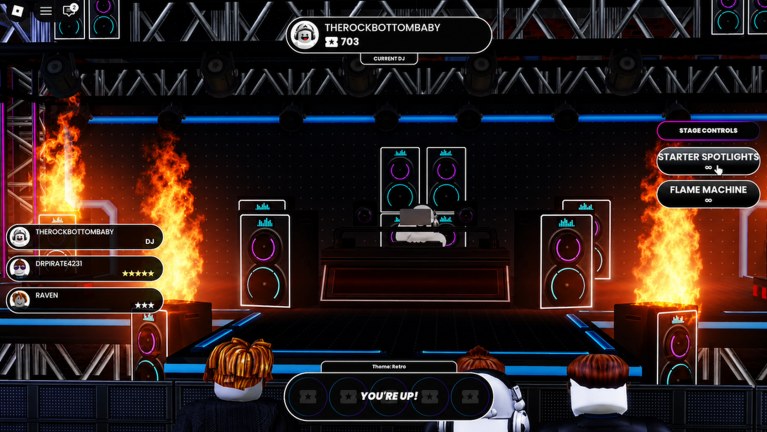
Winning a Beat Battles set is a crowd problem, not a crate problem. You are on a 25-player Roblox server. The HUD names a Current DJ, posts a theme such as Retro, flashes YOU’RE UP! when the queue reaches you, and collects star votes while you play. The studio work that feeds that moment is already covered on How to Remix Loops. This page is what you do with a finished 8–16 bar stack once the stage can hear it: front-load energy, match the theme, use Starter Spotlights and the Flame Machine with taste, vote like someone who still wants stars next round, and stop rambling. Unlocks you climb after wins — effects, stages, DJ Decks — live on the effects tier list, the stages tier list, and the DJ Decks unlocks. The pre-stage punch list lives on the remix checklist.
Front-load energy
Stars start landing in the first bars. There is no cinematic credit sequence. If Drum is missing, Bass is late, and the hook waits until bar twelve, the crowd has already decided you are the empty set. Open with kick, low end, and the identity of the track — Guitar or Piano Roll — in the first four bars. Variation can happen in bars 5–8. A peak can happen in the last four. The opening cannot be a fade-in you find tasteful in a bedroom DAW.
Front-loading is also why 8–16 bars beat a rambling 32. A short stack that is fully on from bar one reads as a performance. A long stack with a timid intro reads as a loading screen. If you need a checklist to catch timid intros before you queue, use the remix checklist and then come back here for the social half.
Match the posted theme
Read the theme before you queue, and again while you wait. Retro is the named example: simpler drums, less FX wallpaper, a hook the room can catch without a lecture. Matching theme is not a promise that Overtune has a huge labeled playlist. It is a promise that the crowd just heard a room and will reward the next DJ who belongs in it. If your stack is a different era, swap Guitar or thin FX in the studio. Do not try to theme-match with Stage Controls. Spotlights do not turn a mismatched bassline into Retro.
Listen to the Current DJ as research, not as background. How long did they play. Where did stars jump. Which lane was loudest. Steal the length and the energy curve, not their clips. Then play your own 8–16 bars when YOU’RE UP! hits, already mixed for that room.
Use Starter Spotlights and the Flame Machine with taste
Stage Controls currently include Starter Spotlights and the Flame Machine. They dress a downbeat or a hook. They are not a substitute for Bass and they are not a vote multiplier you can grind. Fire one look at the moment the hook lands, then let the music work. Spamming flames through a quiet intro tells the crowd you know the set is thin. Leaving spotlights on for a whole rambling repeat tells the crowd you are hiding the repeat.
Longer effect unlocks — the catalogue you climb with production level — are ranked on the effects tier list. Stages you unlock for the room itself are ranked on the stages tier list. Day-one winning does not require those catalogues. It requires one tasteful use of the starter tools, or no use at all if the stack already speaks. A clean set with no flames beats a messy set with constant fire.
Star votes are politics in a 25-player room
The crowd assigns stars. You are in that crowd when you are not up. Vote every set you actually heard. Vote the hook you remember, not the username you like. A server this small notices who never votes, who only tanks rivals, and who inflates a friend’s empty intro. You do not need a conspiracy chart. You need a habit: if you listened, you star.
Do not beg in chat during your own set. Do not stall the queue. Do not leave the server the moment you finish so you can dodge voting. Those are the cheap ways to lose the next round before it starts. The players who climb billboards treat stars as a loop: perform, vote, listen, perform. Production level follows that loop more reliably than a Full Pack Crate.
Short sets versus rambling
Play the 8–16 bars you finished. Stop. A second pass of the same stack can work if the first pass already had energy and you mark the repeat with one change — a thinner FX tail, a spotlight on the last hook. A third pass of empty drums is how stars fall off. Battles are not album playback. They are a live vote with people who can walk to the shop or open chat while you ramble.
If you catch yourself adding four bars of silence as a “breather,” cut them. If you catch yourself explaining the set in chat while it plays, stop typing and let Drum talk. If you catch yourself opening shop on stage, you queued a draft. Go back to How to Remix Loops and finish the draft in the studio.
After a win, and after a loss
A win is not a crate trigger. Bank gems for the lane that actually felt thin, then look at DJ Decks when the catalogue is the real limit — that spend argument lives on DJ Decks unlocks. Stages and effects are the same story: climb them because the room and the dressing should match the music you already make, not because a loss stung.
A loss is usually one of four holes: timid intro, theme mismatch, rambling length, or a crowd you ignored when you were not up. Fix the hole you can name. Run the remix checklist if you cannot name it. Then queue again in the same session while the theme is still in your ears. Billboard climb is a count of finished, voted, short sets — not a count of unopened crates.
A stage script you can reuse
- Finish 8–16 bars drums-first in the studio. Front-load kick, bass, and hook.
- Read the theme. Swap any clip that belongs in a different room.
- Queue. Watch Current DJ. Vote the sets you hear.
- When YOU’RE UP!, play the stack you already have. Do not remix live.
- If you touch Stage Controls, fire Starter Spotlights or the Flame Machine once at the hook.
- End the set before it becomes a loop of silence. Leave the stage and vote the next DJ.
- Unlock decks, stages, and effects only to support the next short set, not to postpone it.
That script is how you win without pretending Beat Battles is a tap-arrow contest or a beat-battle.net lobby. It is a studio plus a room full of voters. Give the room something loud, on-theme, and short.
Frequently Asked Questions
Quick answers for remixing, voting, and climbing Beat Battles billboards.
What actually wins star votes in Beat Battles?
A short 8–16 bar set that is loud from bar one, matches the posted theme, and leaves the crowd a hook to remember. Stage dressing is optional; empty intros are not.
How should I use Starter Spotlights and the Flame Machine?
Once, at the hook. They are show dressing, not a vote hack. Longer unlocks are ranked on the effects tier list.
Does voting other DJs change my results?
A 25-player server notices who never votes and who only tanks rivals. Star every set you heard. Treat votes as part of the loop, not as a hidden combo.
How long should a battle set be?
Eight to sixteen bars, maybe one marked repeat. Rambling empty passes lose stars. Finish length in the studio with How to Remix Loops.
Should I buy crates after a loss?
No. Fix intro, theme, or length first. Run the remix checklist. Buy loops only for a silent lane; look at DJ Decks when the catalogue is the real limit.
Do stages matter as much as the music?
The room helps, but a mismatched or timid stack still loses. Climb stages using the stages tier list after you can already front-load a hook.